
Ce printemps, les oiseaux chantent librement.
Aidez Oiseaux.net à rester libre, gratuit et sans pub.
Goldcrest
Regulus regulus - Roitelet huppé
Systematics
-
Order:
Passeriformes
-
Family:
Régulidés
-
Genus:
Regulus
-
Species:
regulus
Descriptor
Biometrics
- Size: 9 cm
- Wingspan: -
- Weight: 5 à 7 g
Longevity
7 years
Geographic range
Identification
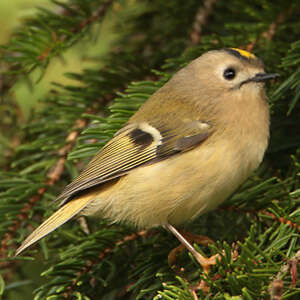
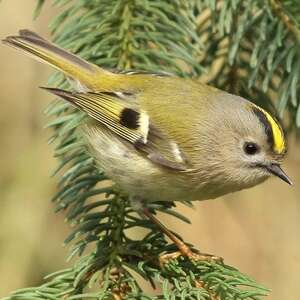
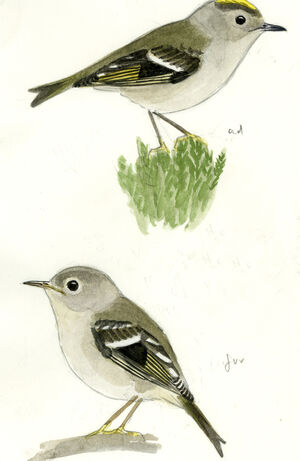
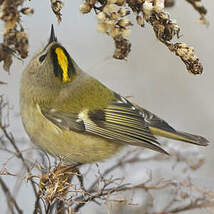
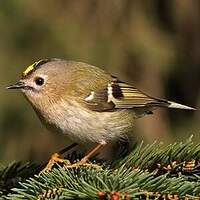
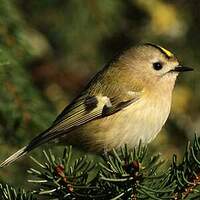
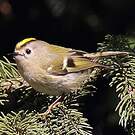
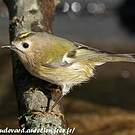
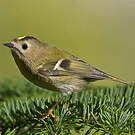
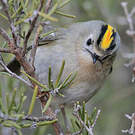
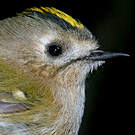
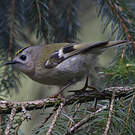
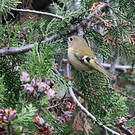
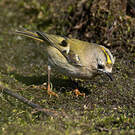
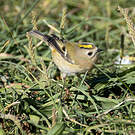
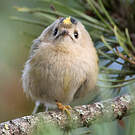
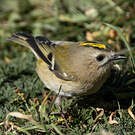
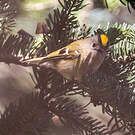
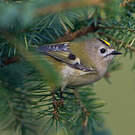
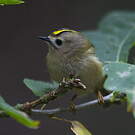
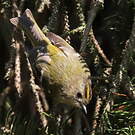
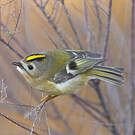
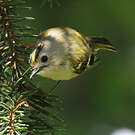
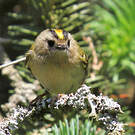
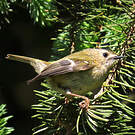
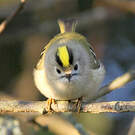
The Goldcrest is, along with its congener the Firecrest, one of the two smallest birds in Europe. They weigh only 5 to 5.5 grams. At first glance, they are tiny birds with a green appearance. To distinguish them, there is the song, which is the easiest, but this is only valid in spring. Otherwise, you have to look at the head. The most visible difference is on the side. The Firecrest has a black band around its eye, which is very visible against a white background, while the Goldcrest does not. Its dark eye circled with whitish gives it a kind of astonished look.
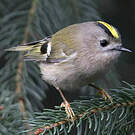
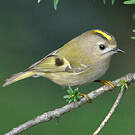
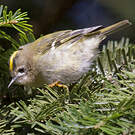
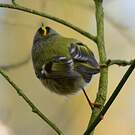
Like the other one, the crown has three longitudinal bands, a medium, wide, orange or yellow surrounded by two blacks. This is where the small sexual dimorphism is located. The middle band is yellow-orange in the male, yellow-lemon in the female. These colored feathers can be erected in a short crest when the bird is excited or anxious. The sides of the head and the nape are shaded with gray. The beak is black, thin and pointed.
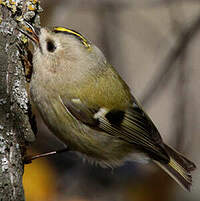
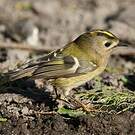
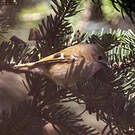
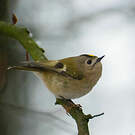
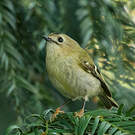
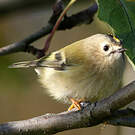
The mantle and flight covers are olive green. The broad and round wings have two white wing bars. The primary feathers and rectrices are dark, edged with green, the first ones barred with black at their base. The tertiaries are tipped with white. The underside is beige to light chamois. The legs and fingers are light brown. The Goldcrest has strong fingers to grip the prickly branches of conifers.
The juvenile is similar to adults, but without the bands of the crown, which will only appear at the next post-juvenile molt, giving it an even more open face than that of adults.
Subspecific information 14 subspecies
- Regulus regulus regulus (Europe and w Siberia)
- Regulus regulus teneriffae (La Gomera and Tenerife. wc Canary Is..)
- Regulus regulus ellenthalerae (La Palma and El Hierro. w Canary Is..)
- Regulus regulus azoricus (São Miguel. e Azores.)
- Regulus regulus sanctaemariae (Santa Maria. se Azores.)
- Regulus regulus inermis (w and c Azores)
- Regulus regulus buturlini (Crimea, Asia Minor and the Caucasus area)
- Regulus regulus hyrcanus (se Azerbaijan and n Iran)
- Regulus regulus coatsi (sc Siberia)
- Regulus regulus tristis (Tien Shan Mts.. c Asia.)
- Regulus regulus himalayensis (e Afghanistan to w Himalayas)
- Regulus regulus sikkimensis (e Himalayas to nc China)
- Regulus regulus yunnanensis (c and sc China, ne Myanmar)
- Regulus regulus japonensis (se Siberia, ne China, Korea and Japan)
Foreign names
- Roitelet huppé,
- Reyezuelo sencillo,
- estrelinha-de-poupa,
- Wintergoldhähnchen,
- sárgafejű királyka,
- Goudhaan,
- Regolo,
- kungsfågel,
- Fuglekonge,
- králik zlatohlavý,
- králíček obecný,
- Fuglekonge,
- hippiäinen,
- reietó eurasiàtic,
- Glókollur,
- mysikrólik (zwyczajny),
- zeltgalvītis,
- rumenoglavi kraljiček,
- Желтоголовый королёк,
- キクイタダキ,
- 戴菊,
- kungsfågel,
- 戴菊,
Voice song and call
The call is a very high-pitched, very piercing sit often repeated. Its very high frequency may be inaudible to some ears. It is primarily a call for contact. The song, lasting for a few seconds, consists of the repeating of identical syllables such as psisisipsisisipsisisipsisisi... and ends with a variable motif such as sritiTui. It is variable from individual to individual.
Habitat
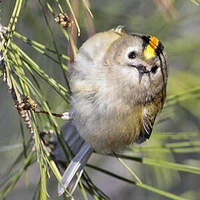
The Goldcrest reproduces in coniferous and mixed forests, secondarily in large gardens and parks planted with conifers. Outside of the breeding season, especially during migration, it also frequents deciduous trees, bushes, hedges, etc. On the Atlantic Islands, it is a resident in the mountain laurel forest.
Behaviour character trait
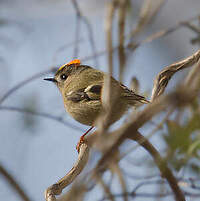
The Goldcrest is a very small but highly active bird. It is always flitting in and around the canopy, always moving around inspecting the green branches.
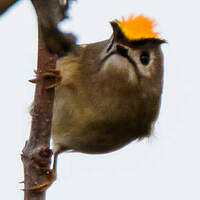
Goldcrests are vulnerable during very cold winters. If winters are mild, mortality is lower and more birds are able to reproduce the following year. In the winter, these birds feed all day and spend the night together, huddled together in dense vegetation. It is still amazing to see such small birds overwintering so far north. It is proof that they find their sustenance where the human eye sees nothing.
Flight
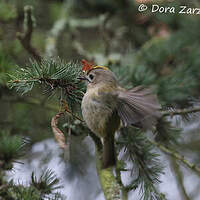
The Goldcrest can easily fly through dense vegetation, and flutter to find its prey with its wide, rounded wings.
Dietfeeding habits
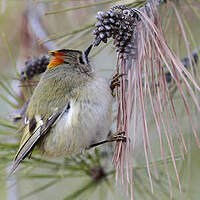
The Goldcrest is an exclusive insectivore. It mainly searches for prey of small to very small size, such as collembolans, aphids, and small nocturnal butterflies.
Reproduction nesting
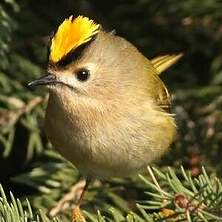
The breeding activity starts in late March but intensifies in April. Sedentary males sing to establish their territory and attract females.
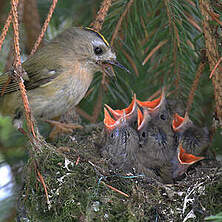
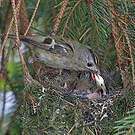
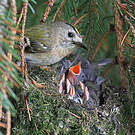
The nest of the Goldcrest is more than hemispheric in order to limit heat loss. It is built by both parents but mainly by the male in a well-foliaged part of a conifer branch, usually more than 10 meters above the ground. This can take almost three weeks of work. The nest consists of three layers. The outer layer is made of moss and lichens attached with spider silk and firmly attached to thin branches. The middle part is made of moss and lined inside with hairs and especially hundreds of small feathers forming the inner layer.
The female lays 6 to 12 pale beige eggs without spots, at the rate of one per day. Incubation lasts fifteenth days and starts before all the eggs are laid. The female covers the chicks in the first few days after hatching. She is fed in the nest by the male. Then the two adults share the feeding of the young which leave the nest at the age of 17 to 22 days but they will still be fed for a fifteenth of days. A second clutch may occur, a bit less productive than the first.
Geographic range
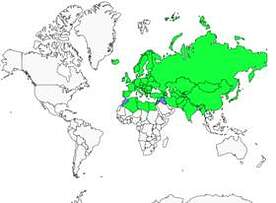
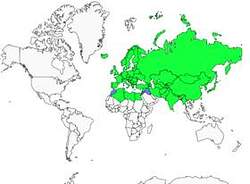
The Goldcrest is distributed throughout Eurasia, with discontinuities in China, and on certain Atlantic islands. On the continent, it is linked to coniferous forests in temperate and boreal latitudes. 15 subspecies are described. The ssp type described above occupies Europe and western Siberia. 5 ssp are endemic to two Macaronesian archipelagos, 2 to the Canaries and 3 to the Azores. The ssp buturlini is in Anatolia and the Caucasus region. hyrcanus is south of the Caspian Sea. The last ones are in East Asia.
The species is resident or partially migratory. Birds from northern Scandinavia and northern Siberia are migratory.
Threats - protection
IUCN conservation status
concern
in the Wild
threatened
evaluated
The range of the Goldcrest is vast and, as such, the species is not threatened. However, it is still reported to be in decline by BirdLife. It can suffer from very harsh winters, which are becoming less common nowadays.

Sources of information
- IOC World Bird List (v15.1), Gill, F and D Donsker (Eds). 2025-12-07.
- Les passereaux d'Europe, tome 2, P. Géroudet, M. Cuisin
- Avibase, Lepage Denis
- Birds of the World, The Cornell Lab of Ornithology
- xeno-canto, Sharing bird sounds from around the world,
Other sources of interest
 Specification sheet created on
28/10/2023 by Jean François
Specification sheet created on
28/10/2023 by Jean FrançoisTranslation by AI Oiseaux.net
© 1996-2026 Oiseaux.net
- Accipitriformes
- Aegotheliformes
- Anseriformes
- Apodiformes
- Apterygiformes
- Bucerotiformes
- Caprimulgiformes
- Cariamiformes
- Casuariiformes
- Charadriiformes
- Ciconiiformes
- Coliiformes
- Columbiformes
- Coraciiformes
- Cuculiformes
- Eurypygiformes
- Falconiformes
- Galliformes
- Gaviiformes
- Gruiformes
- Leptosomiformes
- Mesitornithiformes
- Musophagiformes
- Nyctibiiformes
- Opisthocomiformes
- Otidiformes
- Passeriformes
- Pelecaniformes
- Phaethontiformes
- Phoenicopteriformes
- Piciformes
- Podargiformes
- Podicipediformes
- Procellariiformes
- Psittaciformes
- Pterocliformes
- Rheiformes
- Sphenisciformes
- Steatornithiformes
- Strigiformes
- Struthioniformes
- Suliformes
- Tinamiformes
- Trogoniformes