
Ce printemps, les oiseaux chantent librement.
Aidez Oiseaux.net à rester libre, gratuit et sans pub.
Saddle-billed Stork
Ephippiorhynchus senegalensis - Jabiru d'Afrique
Systematics
-
Order:
Ciconiiformes
-
Family:
Ciconiidés
-
Genus:
Ephippiorhynchus
-
Species:
senegalensis
Descriptor
Biometrics
- Size: 150 cm
- Wingspan: 240 à 270 cm.
- Weight: 6,16 à 7,5 kg
Longevity
36 years
Geographic range
Identification
The vernacular name is ambiguous; in fact, the term Jabiru applies to three species of birds in the Ciconiidae family: the African Saddle-billed Stork (Ephippiorhynchus senegalensis), the Asian Saddle-billed Stork (Ephippiorhynchus asiaticus) and the American Jabiru (Jabiru mycteria). But only the American Jabiru belongs to the Jabiru genus.
A large bird, the Jabiru is, along with the African Marabout, the largest stork species.
Its size is 1.45 to 1.50 m for a wingspan of 2.40 to 2.70 m. The male is larger and heavier than the female.
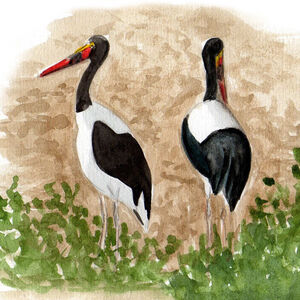
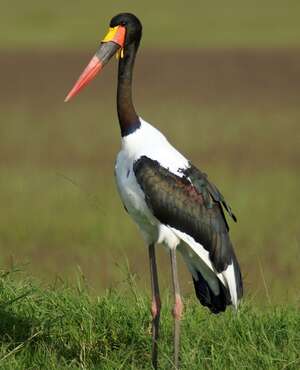
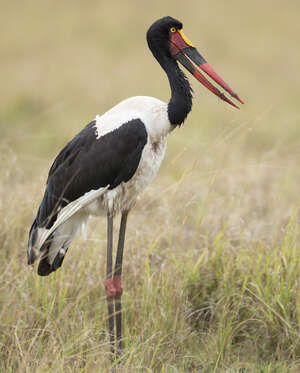
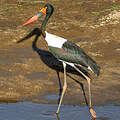
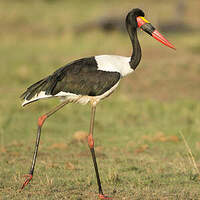
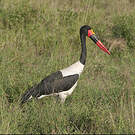
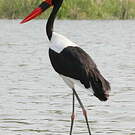
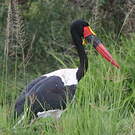
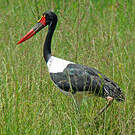
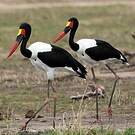
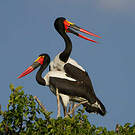
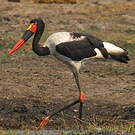
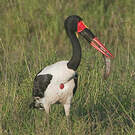
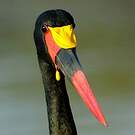
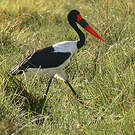
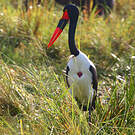
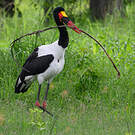
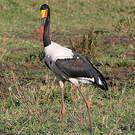
It is an elegant wader with a bicolored plumage identical for both sexes.
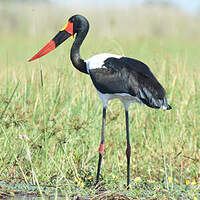
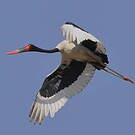
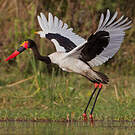
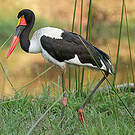
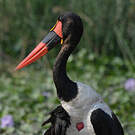
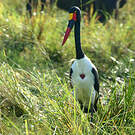
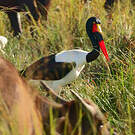
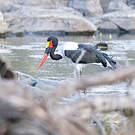
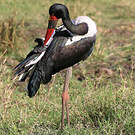
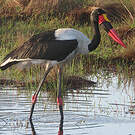
The head, neck, wings (outside the remiges) and tail are iridescent black. The rest of the body is white.
The tibias and tarses are black. The joint and fingers are orange-red.
The chest has a small area of bare skin red. Its color intensifies during the breeding period.
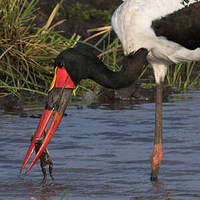
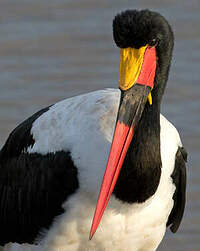
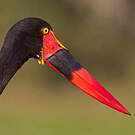
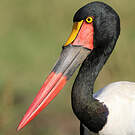
The beak, long and large, is slightly curved upwards. Bright red in color, it has a yellow plate in the shape of a saddle at its upper base. It is from this particularity that it takes its English name of Saddle-billed Stork (literally stork with a saddle beak). In the second quarter of its length, the beak is striped with a wide black band.
Sexual dimorphism is only characterized by golden yellow eyes for the female, dark brown for the male and two small caruncles at the base of the lower jaw for the latter.
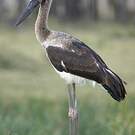
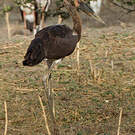
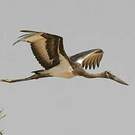
The juvenile is generally rather gray. Its plumage is bicolored but much less contrasted than that of adults. Their beaks are entirely gray-brown.
Subspecific information monotypic species
Foreign names
- Jabiru d'Afrique,
- Jabirú africano,
- jabiru-africano,
- Sattelstorch,
- nyerges gólya,
- Zadelbekooievaar,
- Cicogna sellata,
- sadelnäbbsstork,
- Sadelnebbstork,
- bocianovec sedlatý,
- čáp sedlatý,
- Saddelnæb,
- afrikansatulahaikara,
- Saalbekooievaar,
- jabirú africà,
- żabiru afrykański,
- Седлоклювый ябиру,
- クラハシコウ,
- 鞍嘴鹳,
- sadelnäbbsstork,
- 凹嘴鸛,
Voice song and call
The Saddle-billed Stork is a silent bird. However, like other storks, it emits clattering sounds (quick beak clicks) often near or at nesting sites.
Habitat
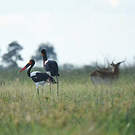
The Saddle-billed Stork frequents various types of aquatic zones with important fisheries resources. It can be observed in marshes, lakes with fresh or alkaline or brackish water, ponds, riverbanks with low flow, and in wet or flooded savannah. Avoiding forest zones, this species can be encountered in open or semi-arid areas.
Behaviour character trait
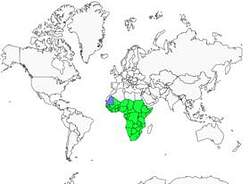
The Saddle-billed Stork is a sedentary wading bird, with a wide range. It does move locally, however, in order to fulfill its food requirements during times of drought or flooding rivers.
On occasion, small flocks of 10-12 individuals can be seen.
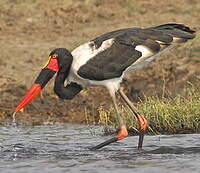
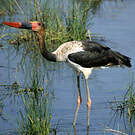
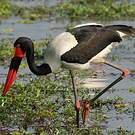
The Saddle-billed Stork hunts by standing still and waiting for prey, or slowly walking through water shallow water - similar to the way herons do. It will also dig through muddy water and vegetation with its beak, like the Wood Storks (Mycteria sp.), or stir the water with its long legs to dredge up prey. Watch a video here and here.
Its long, powerful beak then snaps shut on prey at lightning speed. Once caught, the fish are swallowed head first, followed by a gulp of water.
Flight
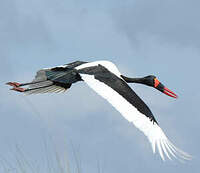
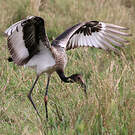
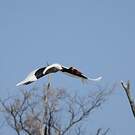
The silhouette of the Saddle-billed Stork in flight resembles that of a stork. The flapping of the wings is slow and powerful. The species glides well and is able to reach high altitudes thanks to thermal updrafts.
Dietfeeding habits
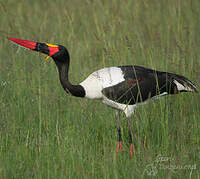
The diet consists primarily of fish (15 to 30 cm long, reaching up to 500 g), crustaceans and frogs. A significant contribution is made by reptiles, small mammals, young birds, mollusks and insects (for example, large aquatic beetles). Saddle-billed Storks are known to feed on any of these items.
Reproduction nesting
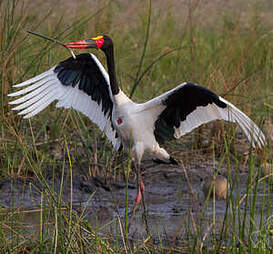
The Saddle-billed Stork is a monogamous bird, with both partners often seen together. The solitary nesting couple builds its nest in the top of an isolated tree (often 20 to 30 metres high) near to a body of water and away from disturbances.
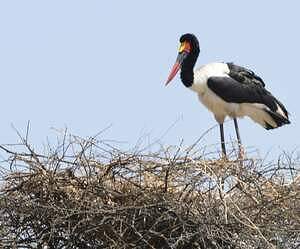
Large (around 2 metres) and relatively flat (50 cm deep), it is made up of branches and reeds. The interior is lined with mud and sedges. The same nest, with a supply of new material, is often reused for several nesting episodes.
The start of the breeding period is usually at the end of the rainy season or during the dry season. The female usually lays two or three eggs which are incubated for 30 to 35 days. Alternately, both members of the couple share the incubation. Once born (covered in white down, weighing around 90 grams), the chicks are fed by both parents, who regurgitate food and water so they do not suffer from the heat and dehydration. They leave the nest at an age that varies between 70 and 100 days. Despite the care of the parents, often only one chick survives.
Reproduction does not necessarily take place every year. Adults tolerate the presence of the juveniles until the age of one or two years on their territory. Sexual maturity is often reached after the third year.
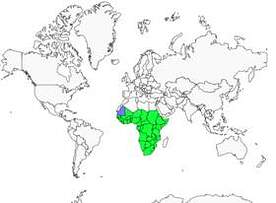
Geographic range
Threats - protection
IUCN conservation status
concern
in the Wild
threatened
evaluated
Although populations of Saddle-billed Storks are relatively stable, they are nevertheless still declining due to threats and changes affecting wetlands (such as drying out for agriculture, contamination from the use of pesticides and various water pollutants). This decline is not considered to be fast enough to consider the species as vulnerable. It is therefore classified as a minor concern (Least Concern 2010). In South Africa and Swaziland it may be considered as disappearing and globally threatened in Mozambique.
Sources of information
- IOC World Bird List (v15.1), Gill, F and D Donsker (Eds). 2025-12-07.
- Vol. 1 - Handbook of the Birds of the World, Josep del Hoyo-Andrew Elliot-Jordi Sargatal
- Wikipédia, Wikipedia, The Free Encyclopedia
- BirdLife International, BirdLife International
- Avibase, Lepage Denis
- IUCN Red List of Threatened species,
Other sources of interest
 Specification sheet created on
29/07/2023 by Yvonnik Lhomer
Specification sheet created on
29/07/2023 by Yvonnik LhomerTranslation by AI Oiseaux.net
© 1996-2026 Oiseaux.net
- Accipitriformes
- Aegotheliformes
- Anseriformes
- Apodiformes
- Apterygiformes
- Bucerotiformes
- Caprimulgiformes
- Cariamiformes
- Casuariiformes
- Charadriiformes
- Ciconiiformes
- Coliiformes
- Columbiformes
- Coraciiformes
- Cuculiformes
- Eurypygiformes
- Falconiformes
- Galliformes
- Gaviiformes
- Gruiformes
- Leptosomiformes
- Mesitornithiformes
- Musophagiformes
- Nyctibiiformes
- Opisthocomiformes
- Otidiformes
- Passeriformes
- Pelecaniformes
- Phaethontiformes
- Phoenicopteriformes
- Piciformes
- Podargiformes
- Podicipediformes
- Procellariiformes
- Psittaciformes
- Pterocliformes
- Rheiformes
- Sphenisciformes
- Steatornithiformes
- Strigiformes
- Struthioniformes
- Suliformes
- Tinamiformes
- Trogoniformes